



If you’ve registered for CA Final under ICAI’s New Scheme, there’s a good chance SPOM has confused you more than any actual subject in your syllabus. You’ve probably seen conflicting information: some say it’s “just an online video,” others say it’s a full exam you can fail. Some blogs still describe only Set A and Set B, as if Set C and Set D don’t exist — which tells you they haven’t been updated since 2024.
Here’s the truth: SPOM is not optional, it’s not a formality, and you genuinely cannot sit for your CA Final written exams without clearing it. But it’s also far less intimidating once you understand exactly what it is, how the hours-plus-test structure works, and how the four sets differ from each other.
This guide breaks down everything current for the 2026 exam cycles — what each Set covers, how many hours you need, how the actual test (SPMT) is structured and scored, and a step-by-step process to get through all four sets without losing months of your preparation timeline.
Quick Answer: CA Final SPOM (Self-Paced Online Modules) consists of four sets — Set A (Corporate & Economic Laws) and Set B (Strategic Cost & Performance Management), both mandatory 40-hour modules, plus Set C and Set D, each a 20-hour elective module where you pick one subject from a basket of options. After completing the required hours on ICAI’s Digital Learning platform, you must clear a separate 100-question MCQ test (SPMT) for each set with a minimum of 50% per module — there’s no aggregate, no negative marking, and no cap on attempts.
What Is CA Final SPOM? And How It Differs from SPMT
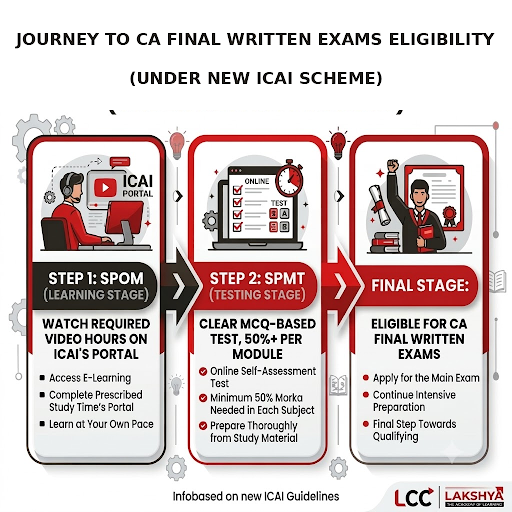
SPOM stands for Self-Paced Online Modules. It’s a set of four learning modules — Set A, B, C, and D — that ICAI introduced under the New Scheme of Education and Training (2024) for CA Final students. You access the content, watch the prescribed video hours, and study the material on ICAI’s Digital Learning platform, at your own pace, around your articleship and other exam prep.
Here’s where most students trip up: SPOM (the learning module) and SPMT (the test that qualifies you) are two different things joined together. You don’t just “watch the videos and move on” — after completing your hours, you have to appear for and pass a separate assessment called the Self-Paced Module Test (SPMT) for that specific set. Clearing SPOM really means clearing both stages: hours completed and SPMT passed.
Why ICAI Introduced SPOM
Under the earlier scheme, CA Final had 8 written papers. ICAI’s New Scheme reduced this to 6 core papers, but two subject areas — Corporate & Economic Laws and Strategic Cost & Performance Management — didn’t disappear from the curriculum; they moved out of the written exam format entirely and into these self-paced online modules instead. Sets C and D were added on top as India’s CA curriculum moved toward building well-rounded professionals with exposure to areas like forensic accounting, ESG/sustainability reporting, digital controls, and even constitutional literacy — topics that don’t fit neatly into a traditional written-paper format but are increasingly relevant to modern CA practice.
In short: SPOM didn’t reduce your workload, it restructured it — shifting two full subjects and four elective areas into a self-paced, test-based format instead of a written exam.
SPOM Set A: Corporate & Economic Laws
Status: Mandatory
Learning hours required: 40 hours
Set A covers company law, SEBI regulations, economic offences, and related corporate law case studies — essentially the legal backbone every practicing CA needs, even though it no longer appears as a written paper. Expect coverage of:
- Companies Act provisions relevant to CA practice
- SEBI regulations and securities law essentials
- Economic offences and enforcement mechanisms
- Applied case studies testing legal reasoning, not just memorisation
This module tends to feel closer to the old “Corporate and Economic Laws” content CA Final students studied earlier — if you’ve seen that syllabus before, Set A won’t feel unfamiliar in substance, just different in delivery format.
SPOM Set B: Strategic Cost & Performance Management
Status: Mandatory
Learning hours required: 40 hours
Set B focuses on cost control strategies, performance evaluation frameworks, and advanced managerial decision-making tools — the strategic layer of cost and management accounting that used to sit inside CA Final’s core papers. Core areas typically include:
- Strategic cost management techniques
- Performance measurement and evaluation systems
- Decision-making tools for cost control and efficiency
- Applied scenarios linking cost strategy to business performance
If AFM (Advanced Financial Management) or cost accounting were subjects you enjoyed at the Intermediate level, Set B will feel like a natural, strategic extension of that thinking.
SPOM Set C: Elective Modules (Pick 1)
Status: Mandatory to clear, but you choose 1 subject
Learning hours required: 20 hours
Set C is where SPOM starts feeling less like “extra work” and more like genuine specialization. You pick one subject from a basket of electives — and this choice, once made at registration, is typically final, so it’s worth thinking through rather than picking randomly.
| Set C Elective Options |
|---|
| Risk Management |
| Sustainable Development and Sustainability Reporting |
| Public Finance and Government Accounting |
| Insolvency and Bankruptcy Code (IBC) |
| International Taxation |
| Forensic Accounting |
| Valuation |
| Financial Services and Capital Markets |
| Forex and Treasury Management |
SPOM Set D: Multidisciplinary Modules (Pick 1)
Status: Mandatory to clear, but you choose 1 subject
Learning hours required: 20 hours
Set D is ICAI’s attempt to build well-rounded professionals beyond pure accounting and finance — think of it as the “soft skills meet real-world literacy” module.
| Set D Multidisciplinary Options |
|---|
| Constitution of India and Art of Advocacy |
| Psychology and Philosophy |
| Entrepreneurship and Start-up Ecosystem |
| Digital Ecosystem and Controls |
Who Needs to Clear Which Sets? Eligibility by Admission Date
This is the part that causes the most confusion online, because your SPOM requirement genuinely depends on when you were admitted to CA Final, not just which attempt you’re targeting. ICAI has issued specific transition rules for students moving between the old and new schemes.
| When You Were Admitted to CA Final | SPOM Sets Required |
|---|---|
| Till November 2023 (transitioning from old scheme) | Set A and Set B only — exempt from Set C and D |
| Around May 2024 (transitional cohort) | May be exempt from Set C and D depending on exact transition status |
| New Scheme registrants after the above cutoffs | Must clear all four — Set A, B, C, and D |
Because these transition rules are cohort-specific and have been updated more than once by ICAI, always cross-check your exact exemption status on the official ICAI Digital Learning Campus or through your regional ICAI office rather than relying solely on blog posts (including this one) — your registration date and course transition history determine your exact requirement.
SPMT Exam Pattern & Passing Criteria
Once your learning hours are complete for a set, you book a slot for the SPMT (Self-Paced Module Test) — this is the actual qualifying exam, and it’s where students most often underestimate the preparation needed.
| Feature | Detail |
|---|---|
| Exam mode | Offline, at designated exam centres |
| Number of centres | 269+ centres across India, plus international centres |
| Questions per module | 100 MCQ-based questions |
| Negative marking | None |
| Passing criteria | Minimum 50% in each module (no aggregate across sets) |
| Number of attempts allowed | Unlimited |
| Exam frequency | Conducted on an ongoing/rolling basis — not tied to May/Sep/Jan exam windows |
The 50%-per-module, no-aggregate rule is genuinely good news: you can’t “carry” a strong Set B score to compensate for a weak Set C attempt. Each module stands alone, which also means there’s no reason to panic if one test goes badly — you simply re-book and retake that specific module, with no cap on how many times you can attempt it.
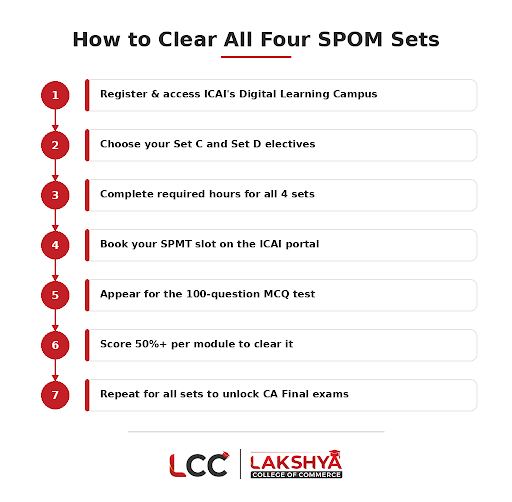
Step-by-Step: How to Clear All Four SPOM Sets
STEP 1 → Register for CA Final and get access to
ICAI’s Digital Learning Campus
│
▼
STEP 2 → Choose your Set C elective (1 of 9 options)
and Set D elective (1 of 4 options)
│
▼
STEP 3 → Complete 40 hours each for Set A & Set B,
and 20 hours each for Set C & Set D
│
▼
STEP 4 → Book your SPMT slot for each completed set
via the ICAI portal
│
▼
STEP 5 → Appear for the 100-question MCQ test per set
at your chosen exam centre
│
▼
STEP 6 → Score 50%+ in that module to clear it
(retake immediately if you fall short — no cap)
│
▼
STEP 7 → Repeat for all four sets — once complete, you’re
eligible to register for CA Final written exams
Practical tip on sequencing: most rank holders and mentors recommend clearing Set A and Set B early — ideally right after CA Final registration and before your articleship workload peaks — since these carry the heavier 40-hour commitment. Save Set C and Set D for a phase when you have shorter, more flexible study windows, since 20 hours is easier to slot around other commitments.
How to Choose Your Set C & Set D Electives
Since your Set C and D choice is typically locked in at registration, treat it as a real decision, not an afterthought:
- Align with your career direction. If you’re aiming for a career in taxation or international assignments, International Taxation under Set C is directly relevant. Eyeing consulting, restructuring, or distressed-asset work? IBC or Forensic Accounting builds a more relevant foundation.
- Consider what genuinely interests you. Since these are self-paced and less exam-pressure-heavy than your core papers, picking a subject you find intellectually engaging (say, Valuation if you enjoy AFM-style problems) tends to make the 20 hours feel far less like a chore.
- For Set D, don’t dismiss the “soft” options. Digital Ecosystem and Controls is increasingly relevant given how much of modern audit and assurance work now touches IT systems and data controls — worth serious consideration even if it feels less “core” than the other three options.
- Talk to seniors who’ve already cleared SPOM under the new scheme — real feedback on which electives had clearer video content or more predictable SPMT question patterns is more useful than guessing from the syllabus title alone.
Common Mistakes Students Make with SPOM
- Leaving all four sets until the last minute, right before wanting to register for CA Final written exams — this creates unnecessary time pressure when it’s completely avoidable with early planning.
- Treating SPOM as “just videos” and skimming through the hours without actually absorbing content, then being caught off guard by the SPMT’s 100-question format.
- Not checking personal exemption status carefully, especially for students who transitioned from the old scheme, and either skipping a set they actually needed or wasting time on one they were exempt from.
- Booking SPMT slots too close to written exam registration deadlines, leaving no buffer for a retake if the first attempt falls short of 50%.
- Ignoring Set C/D elective choice implications and picking randomly, only to realize later the subject has little relevance to their intended specialization.
SPOM Doesn’t Have to Slow Down Your CA Final Timeline
Cleared strategically — Set A and B early, Set C and D in smaller pockets of time — SPOM adds structure to your CA Final journey rather than delay. The bigger risk isn’t the difficulty of the modules; it’s leaving them piled up right when you should be focused purely on your core paper revision.
If you’d like a structured SPOM completion plan mapped against your CA Final exam timeline — along with guidance on which Set C/D elective fits your career goals — talk to Lakshya Edu’s CA Final mentors for a personalised study roadmap.
FAQs on CA Final SPOM 2026
What is CA Final SPOM?
SPOM (Self-Paced Online Modules) is a set of four learning-and-assessment modules — Set A, B, C, and D — introduced under ICAI’s New Scheme that CA Final students must clear before they’re eligible to appear for their written CA Final exams.
Is SPOM compulsory for all CA Final students?
It’s compulsory for students registered under the New Scheme. Students who transitioned from the old scheme before specific ICAI-notified cutoff dates may be exempt from Set C and Set D — always verify your exact status with ICAI directly.
How many hours do I need to complete for each SPOM set?
40 hours each for Set A and Set B, and 20 hours each for Set C and Set D.
What is the passing criteria for the SPMT exam?
You need a minimum of 50% in each module individually. There’s no aggregate rule across sets, no negative marking, and no limit on the number of attempts.
Can I change my Set C or Set D elective later?
Generally no — the elective chosen at registration is treated as final, so choose deliberately rather than defaulting to whichever option appears first.
Is SPOM the same as SPMT?
No. SPOM refers to the self-paced learning modules (the video hours and study material). SPMT (Self-Paced Module Test) is the separate MCQ-based exam you must clear after completing each module’s required hours.
How is the SPMT exam conducted?
Offline, at designated ICAI exam centres (269+ centres in India plus international centres), with 100 MCQ-based questions per module and no negative marking.