



A structured, faculty-tested framework to plan and finish three complete revisions of the CMA Inter syllabus — without last-minute panic.
Most CMA Intermediate students don’t fail because they didn’t study enough. They fail because they never actually revised — they just re-read. Reading a chapter for the third time and calling it “revision” feels productive, but it rarely improves your recall under exam pressure or your speed on practical problems.
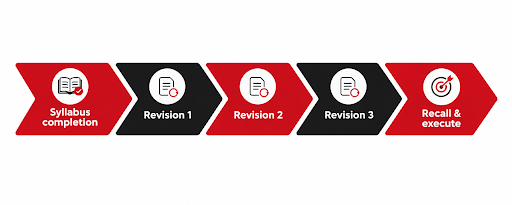
A genuine CMA Intermediate revision strategy is not about how many times you open your books. It’s about what each pass through the syllabus is designed to achieve. This guide breaks the run-up to your exam into three distinct revisions — each with its own goal, method, and output — so you walk into the exam hall having already “written” the paper in your head at least twice before the real thing.
This framework is built around what actually moves scores for ICMAI candidates: concept clarity in Revision 1, speed and accuracy in Revision 2, and pure recall in Revision 3. If you’re targeting the December CMA Inter attempt, you can map this plan onto your own timeline using the checkpoints below.
Want this plan built around your actual exam date?
Lakshya’s CMA Inter Face-to-Face classes in Hyderabad include a structured revision calendar, chapter-wise tests, and weekly mocks built into the course — so you’re never guessing what to revise next.
Why CMA Intermediate Needs a Revision Strategy, Not Just “More Studying”
CMA Intermediate is ICMAI’s second stage of the CMA course, spread across 8 papers in two groups. To clear a group, you need 40% in each individual paper and 50% in aggregate — which means there is no room for one weak paper dragging your average down. With that much syllabus riding on a single attempt held only twice a year (June and December), a student who revises without a plan almost always runs out of time on the papers that need it most: Cost & Management Accounting, Financial Management, and Taxation.
Three structured revisions solve this in a specific way:
- Revision 1 rebuilds conceptual clarity across the full syllabus after your first read-through or classes end.
- Revision 2 builds problem-solving speed and accuracy through timed practice, MCQs, and ICMAI’s own RTPs and MTPs.
- Revision 3 is pure recall and exam simulation — the days where you stop learning anything new and simply retrieve what you already know, fast.
The 3-Revision Framework at a Glance
Think of this as a funnel: broad and slow at the start, narrow and fast by exam day. Each stage has a different job — don’t skip a stage, and don’t let one stage bleed into the next.
Your CMA Intermediate Revision Timeline
If you’re working backward from your CMA Inter exam date, here’s how the 90–100 day run-up typically breaks down. Adjust the exact dates using the official ICMAI schedule on your exam-form confirmation.
Subject-Wise Revision Priority: Category A, B, C
Not every chapter deserves equal revision time. Faculty across CMA Inter coaching consistently group chapters by scoring weightage — Category A (high-weightage, revise first and most), Category B (moderate, revise second), and Category C (low-weightage, revise last and selectively). Here’s how the 8 CMA Inter papers typically split by group:
For the exact chapter-wise weightage and the latest ICMAI paper structure, cross-check against the CMA Inter Subjects & Syllabus guide before you build your Category A/B/C list.
Revision 1: The Foundation Pass
Goal: touch every chapter in every paper at least once after your classes or first self-study round end, so nothing is unfamiliar going into practice mode.
- Go chapter-by-chapter in your class notes or study material — don’t jump straight to solved problems.
- For every practical chapter, redo at least one worked example by hand instead of just reading the solution.
- Build a single formula and summary notebook as you go — this becomes your Revision 3 recall tool.
- Flag every topic you hesitate on with a simple star system (⭐ = revisit once more, ⭐⭐ = revisit twice). This list drives Revision 2.
- Do not attempt full mock papers yet — Revision 1 is about clarity, not speed.
Revision 2: The Practice Pass
Goal: convert the concepts you rebuilt in Revision 1 into exam speed. This is where most students plateau if they only re-read notes instead of solving fresh problems under time pressure.
- Download and solve ICMAI’s official Revision Test Papers (RTPs) and Mock Test Papers (MTPs) — these are written by the same examiner panel that sets your paper.
- Attempt 100–150 MCQs a day across subjects, since CMA Inter papers now carry a significant objective-question component.
- Time every practical paper attempt at roughly 1.8 minutes per mark to build real exam pacing.
- Revisit every ⭐⭐ topic from your Revision 1 list and redo it from scratch, without looking at the solution first.
- Keep an error log — write down why you got a question wrong (concept gap, calculation slip, or time pressure). This log is gold in Revision 3.
The official RTPs, MTPs, and past papers are published on the ICMAI Directorate of Studies portal — always practise from the latest syllabus set to avoid outdated case laws or amended provisions.
Revision 3: The Recall Pass
Goal: the final 10–15 days are for retrieval, not learning. If you’re still discovering new concepts at this stage, that’s a sign Revision 1 or 2 was rushed — don’t try to fix it by cramming; focus on protecting what you already know.
- Attempt at least 2–3 full-length mock tests per group, written in the actual exam time slot (typically 2 PM–5 PM), under real conditions — no notes, no phone.
- Review every mock paper the same day: mark presentation gaps, silly errors, and timing issues separately.
- Build a Last-Day-Revision (LDR) list — the specific formulas, sections, and problem types you keep forgetting. This is the only thing you read on the morning of the exam.
- Revise theory subjects (Laws & Ethics, Strategic Management) in the last 3–4 days when memory retention matters most and calculation fatigue is lower.
- Sleep and diet matter more here than in any other phase — a tired brain forgets faster than it learns.
Common Revision Mistakes That Cost CMA Inter Students Marks
- Starting revision without finishing the syllabus — you end up revising some chapters twice and others never.
- Treating all three revisions the same — re-reading notes for the third time instead of practising or recalling.
- Ignoring theory papers until the last week — Laws, Ethics, and Strategic Management need at least one dedicated revision pass, not a skim.
- Skipping mock tests — students who go straight from notes to the exam hall consistently mistime their papers.
- No backlog tracking — without a weekly check on what’s pending, revision plans silently collapse in the final month.
Tools & Resources That Speed Up Revision
- ICMAI RTPs & MTPs — the single most reliable practice source, available free on the official ICMAI student portal
- A single formula and mnemonics notebook, colour-coded, built during Revision 1 and used exclusively in Revision 3
- Chapter-wise weightage tables to prioritise Category A topics under time pressure
- Structured mock test series with expert evaluation — Lakshya’s CMA Inter classes build weekly mocks and performance analysis directly into the course calendar
- A live exam-date tracker so your revision windows are anchored to the actual ICMAI schedule — see the CMA Inter Exam Date & Timeline guide
Sample 90-Day, 3-Revision Study Plan
This is a template, not a rigid rule — scale the weeks up or down based on how much of your syllabus is already complete.
Final Word
A CMA Intermediate revision strategy only works if each pass through the syllabus has a distinct job to do. Revision 1 gives you clarity, Revision 2 gives you speed, and Revision 3 gives you recall under pressure. Students who treat all three the same — as one long re-read — are the ones who run out of runway in the final two weeks.
If you’d rather follow a faculty-built calendar than design your own from scratch, explore Lakshya’s CMA Inter Classes in Hyderabad or read our broader CMA India 2026 Career Guide to see how Intermediate fits into your full CMA journey.
Frequently Asked Questions
How many times should I revise CMA Intermediate before the exam?
At minimum, complete two full revisions; three is what consistently separates high scorers from average clearers. The key is that each revision should have a different purpose — concept clarity, then practice speed, then pure recall — rather than repeating the same passive reading each time.
When should I start my CMA Inter revision?
Ideally 3 to 3.5 months before your exam date, right after you finish your first read-through of the syllabus. Starting later compresses all three revision stages into one rushed pass, which is the single biggest reason students run out of time on Group 2’s calculation-heavy papers.
How is revision different from just studying again?
Studying builds new understanding; revision retrieves and strengthens what you already understand. If you’re looking up a concept for the first time during “revision,” that’s actually still first-pass studying — plan for it separately so it doesn’t eat into your practice and recall windows.
How many mock tests should I attempt before CMA Intermediate exams?
Aim for at least 3 to 4 full-length mock tests per group, attempted in the actual exam time slot. Mocks matter less for the score you get and more for exposing timing issues and presentation gaps while there’s still time to fix them.
Should I revise theory or practical papers first?
Start Revision 1 and 2 with practical, calculation-heavy papers (Cost Accounting, Financial Management, Taxation) since they need repeated problem-solving to stay sharp. Save concentrated theory revision (Laws & Ethics, Strategic Management) for the final week, when memorisation retention is highest and calculation fatigue is lowest.