


The Enrolled Agent exam looks manageable on paper: three parts, 100 multiple-choice questions each, no degree required. Yet many candidates still fail a part because they study without a plan, pick the wrong order, or run out of testing window. In 2027, there is one more trap: the IRS moved the exam from Prometric to PSI in 2026, and a lot of online advice still describes the old process.
This guide gives you a practical, part-by-part strategy to clear the Enrolled Agent exam on the first attempt, built on the PSI-era rules and the 2027-28 testing cycle.
Enrolled Agent Exam at a Glance (2027-28 Attempt)
The Enrolled Agent exam is officially called the Special Enrollment Examination (SEE). Since 1 March 2026 it is run by PSI Services, which replaced Prometric. Here is what you need to know before you plan anything.
| Detail | 2027-28 Attempt |
|---|---|
| Parts | Part 1 Individuals, Part 2 Businesses, Part 3 Representation, Practices and Procedures |
| Format | 100 multiple-choice questions per part (15 are unscored experimental questions) |
| Time | 3.5 hours per part |
| Testing window | Expected 1 May 2027 to 29 February 2028 (March and April are a blackout) |
| Fee | 951 for all three): $66 IRS fee + $251 PSI fee |
| Attempts | Up to 4 per part per window, with a 24-hour wait after a fail |
| Score validity | Passed parts carry over for 3 years |
| Tax law tested | Expected: tax year 2026 (law as of 31 December 2026) |
| After passing | Apply on Form 23 ($140) within one year |
Pass rates reported by prep providers range from roughly 60% to 75% per part, but the IRS does not publish official figures. Treat those numbers as a rough guide, not a promise. Dates and tax-year details marked “expected” follow the usual annual cycle, and the IRS and PSI publish final details after the March-April blackout, so verify them before booking. Always confirm fees, dates and rules in the official IRS Enrolled Agent information and the PSI Candidate Information Bulletin before you pay.
Why Passing on the First Attempt Matters
A retake costs another $317, plus lost weeks. With the window expected to close at the end of February 2028, a failed attempt in January can push you into the next cycle, and the exam is then updated for new tax law. Passing each part once is the cheapest and fastest route.
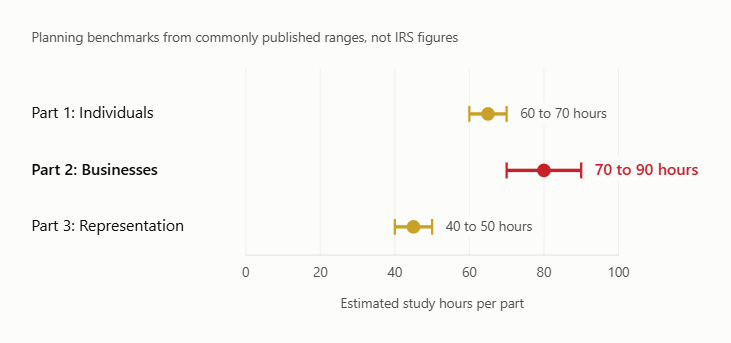
The good news: most candidates need about 40 to 70 study hours per part, which makes the Enrolled Agent exam one of the quicker global tax credentials. If you are comparing options, see our guides on the EA vs US Tax Course.
Step 1: Choose the Right Order for the Three Parts
You can take the parts in any order, so do not default to Part 1 just because it is numbered first. Pick the order that builds momentum.
| Part | What It Tests | Difficulty | Typical Study Time |
|---|---|---|---|
| Part 1: Individuals | Income, deductions, credits, taxation of individuals | Moderate, high volume | 60 to 70 hours |
| Part 2: Businesses | Entities, partnerships, corporations, depreciation, accounting | Highest, widest content | 70 to 90 hours |
| Part 3: Representation | Circular 230, ethics, collections, appeals, penalties | Lower, rule-based | 40 to 50 hours |
Study-hour estimates are our planning benchmarks based on commonly published ranges. Most prep providers rate Part 2 as the heaviest, and Part 3 as the shortest with the best pass rates.
Our recommended sequence:
- Commerce or accounting graduates: Part 1, then Part 3, then Part 2.
- Complete beginners: Part 3 first to build confidence, then Part 1, then Part 2.
- Working professionals with business tax exposure: Part 2 first while you have the most free time.
Step 2: Follow This First-Attempt Flowchart
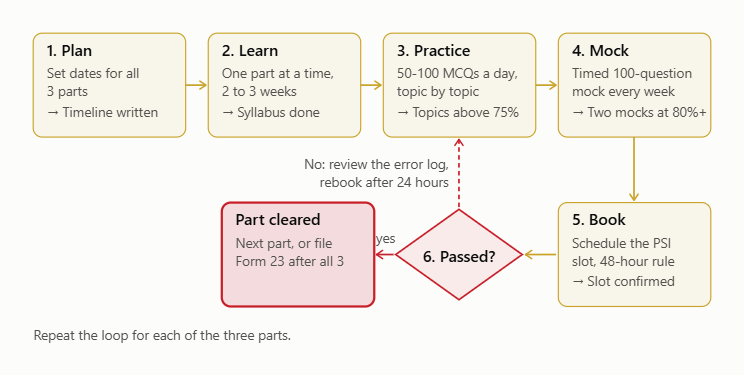
Use this decision flow before you book a single exam slot.
Step 3: Use the 3-Phase Study Method
Phase 1: Concepts (weeks 1 to 3 per part). Study directly from IRS-aligned material and the official content outline. Understand why a rule exists instead of memorising it. This matters because the exam tests application, not definitions.
Phase 2: Practice (weeks 3 to 5). Solve 50 to 100 multiple-choice questions every day. Keep an error log: write the question, why you missed it, and the correct rule. Review the log every weekend.
Phase 3: Mocks and revision (final 7 to 10 days). Take full 100-question mocks in 3.5 hours under exam conditions. Aim for at least 5 to 8 full mocks across all three parts. Use mock results to decide which topics get your last revision hours.
Study one part at a time. Stacking all three together splits your attention and increases confusion between individual and business rules.
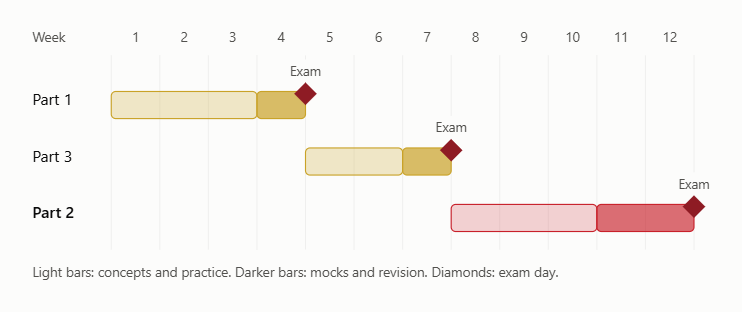
A Sample 12-Week Plan for All 3 Parts
This plan assumes 2 to 3 hours on weekdays and slightly longer on weekends. Adjust it if you are a full-time professional.
| Weeks | Focus | Milestone |
|---|---|---|
| 1 to 3 | Part 1 concepts plus daily MCQs | Complete syllabus |
| 4 | Part 1 mocks and revision | Book and take Part 1 |
| 5 to 6 | Part 3 concepts and practice | Complete syllabus |
| 7 | Part 3 mocks, then exam | Take Part 3 |
| 8 to 10 | Part 2 concepts plus heavy practice | Complete syllabus |
| 11 | Part 2 mocks and error-log review | Two 80% mocks |
| 12 | Final revision, then exam | Take Part 2 |
Testing is closed in March and April, so use that blackout for weeks 1 to 3 and sit Part 1 soon after testing is expected to open on 1 May 2027. Following this plan, you would finish Part 2 around late July 2027, leaving a long buffer before the window closes.
6 Mistakes That Cost Candidates a First-Attempt Pass
- Treating all parts equally. Part 2 needs far more time than Part 3.
- Reading without practising. Passive reading feels productive but does not build exam speed.
- Skipping the official sources. Use the IRS publications and the content outline, since the exam is based on tax law, not on any one course.
- Booking too late. Slots fill up near the end of the window. Book at least 3 to 4 weeks ahead.
- Ignoring the carryover deadline. Passed parts expire after 3 years, so plan the full journey first. Most candidates should finish within 12 to 18 months.
- Not rehearsing the test format. The exam is closed-book, and PSI testing includes scheduled breaks and remote-proctoring rules, so practise on a similar screen.
Exam Day: How PSI Testing Works
Candidates in the US can test at a PSI centre or through remote proctoring. For international candidates, including those in India, remote proctoring is the main route, and PSI’s remote option only began in 2026, so confirm availability and system requirements in the 2027-28 bulletin before planning. Remote testing is stricter, so do a system check, clear your desk and keep your ID ready.
Two practical rules to remember:
- You can generally reschedule without losing the fee until 48 hours before your appointment. After that, you pay again.
- Results appear on screen immediately after you submit.
Schedule through the PSI candidate portal, not through old Prometric links still floating around online.
Is the Effort Worth It?
Yes, for anyone targeting US taxation. The credential is issued by the IRS and grants unlimited representation rights, and it opens doors at Big 4 firms, MNCs and global capability centres. Read 8 reasons Indian finance professionals are choosing the Enrolled Agent certification for career context, and US Taxation vs Indian Taxation for salary and career scope.
Final Takeaway
The Enrolled Agent exam rewards structure. Pick your part order, study one part at a time, practise daily, take full mocks, and book your slots early. With the 2027-28 window expected to open on 1 May 2027, the best time to start your Enrolled Agent exam preparation is the March-April blackout, when you can study but cannot yet test.
Ready to clear all 3 parts of the Enrolled Agent exam on your first attempt?
Join the Enrolled Agent course at Lakshya Edu and prepare with live and recorded classes. No-cost EMI starts at ₹5,999 a month.
Frequently Asked Questions
How many months do I need to prepare for the Enrolled Agent exam?
Most candidates need 3 to 4 months for all three parts, depending on background and weekly hours.
Do I need a degree or work experience?
No. You need a PTIN and must pass all three parts.
Can I take all three parts back to back?
Yes, but taking them one at a time improves retention.
What if I fail a part?
Wait 24 hours, review your error log, and rebook. You can attempt each part up to four times in a testing window.
Is the Enrolled Agent exam open book?
No, it is closed book.
When does the 2027 testing window open?
The usual cycle runs from 1 May to the end of February, with a March-April blackout for updates. Treat 1 May 2027 as expected until PSI confirms it.
Related Reads:
- EA Exam Syllabus 2026: Part 1, Part 2 & Part 3
- 8 Reasons Why Indian Finance Professionals Are Choosing the Enrolled Agent Certification
- EA vs US Taxation Course: Which Is the Right Career Path for Indian Commerce Students?
- US Taxation Vs Indian Taxation: Key Differences, Career Scope & Salary in 2026
- Federal Tax Vs State Tax in the USA: A Complete Guide