



For commerce students and finance professionals in India, this isn’t just trivia. Understanding Federal Tax vs State Tax in the USA is the foundation of US taxation — and US taxation is exactly what qualifications like the Enrolled Agent (EA) course and US CMA are built around. It’s also essential if you’re moving to the US for work or study, or advising clients who do.
This guide breaks down the US tax system in plain language: what federal tax is, what state tax is, how they differ, who collects them, and how they work together — with tables, an infographic, a flowchart, and real 2026 numbers from the IRS.
What Is the US Tax System? (America’s Tax Structure Explained)
This is very different from India’s system, where income tax is levied only at the central level (state governments don’t tax personal income). In the America tax system, you can owe tax to:
- The federal government — always, if your income crosses the filing threshold, no matter which state you live in.
- Your state government — depending on where you live and work, and whether that state taxes personal income at all.
- Sometimes local government — a handful of cities (like New York City and Philadelphia) also levy their own local income tax on top of federal and state tax.
So when people ask “what is the tax in USA?” the honest answer is: it depends on income type, state of residence, and sometimes even the city — because the US doesn’t have one single tax rate. It has layers.
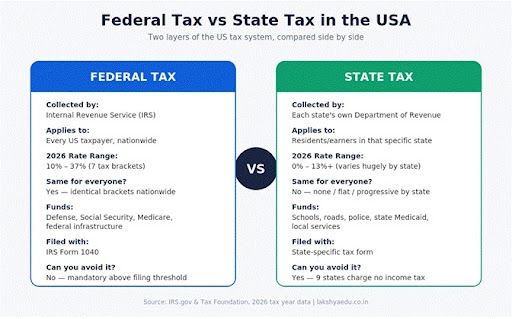
Infographic: Federal Tax vs State Tax at a glance — Source: IRS.gov & Tax Foundation, 2026 data
What Is Federal Tax in the USA?
- Collected by the IRS (Internal Revenue Service), which operates under the US Department of the Treasury
- Governed by the Internal Revenue Code (IRC)
- Progressive — the more you earn, the higher the rate on each additional slice of income (similar in concept to India’s slab system)
- Identical nationwide — a techie in California and a teacher in Texas fall into the exact same federal brackets if their taxable income matches
What Federal Tax Pays For
- National defense and homeland security
- Social Security and Medicare (via payroll tax, a separate federal tax from income tax)
- Federal infrastructure and highway funding
- Interest on the national debt
- Federal agencies (FBI, NASA, IRS itself, etc.)
2026 Federal Income Tax Brackets (IRS)
Source: IRS.gov – Federal income tax rates and brackets (irs.gov/filing/federal-income-tax-rates-and-brackets)
Standard deduction for 2026: $16,100 (Single) / $32,200 (Married Filing Jointly) — this is the amount of income you can earn before federal tax even applies, assuming you don’t itemize deductions.
How progressive tax actually works: A common misconception (that trips up even finance students) is thinking your entire income gets taxed at your top bracket rate. It doesn’t. Only the portion of income that falls inside each bracket is taxed at that bracket’s rate — every dollar below it is taxed at the lower rates first. This is called marginal tax rate taxation, and it’s a core concept tested in the EA exam’s Part 1 (Individuals).
Other Types of Federal Tax
- Payroll tax (FICA) — 6.2% Social Security + 1.45% Medicare, withheld from every paycheck
- Capital gains tax — on profits from selling investments, at separate rates (0%, 15%, or 20% in 2026)
- Corporate income tax — a flat 21% rate on C-corporation profits
- Estate and gift tax — on large transfers of wealth (2026 estate tax exemption: $15 million per person)
What Is State Tax in the USA?
Unlike federal tax, state tax is not uniform. Broadly, states fall into three categories:
A. No Income Tax States (9 states)
Alaska, Florida, Nevada, New Hampshire*, South Dakota, Tennessee, Texas, Washington, and Wyoming
*New Hampshire only taxes certain interest and dividend income, not wages, and is phasing this out.
⚠ Important nuance: “No income tax” does not mean “no tax.” These states usually make up the revenue through higher sales tax, property tax, or excise duties. Texas, for example, has some of the highest property tax rates in the country.
B. Flat Tax States
C. Progressive Tax States
What State Tax Pays For
- Public schools and state universities
- State highways and public transportation
- Police, fire departments, and public safety
- State Medicaid and welfare programs
- State courts and prisons
Federal Tax vs State Tax: Full Side-by-Side Comparison
This is precisely the kind of comparison tested in US CMA case studies and the EA SEE Exam Part 1 (Individuals) — knowing which tax layer a rule belongs to is often the difference between a right and wrong answer.
How Federal and State Tax Work Together: The Filing Flow
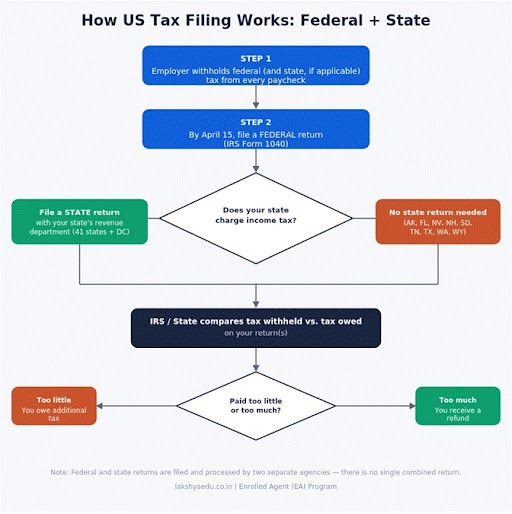
Flowchart: How US tax filing works — federal and state, step by step
Two separate government agencies process these two returns independently — there is no single “combined” US tax return. This is a common shock point for Indian professionals moving to the US on work visas, and it’s exactly the workflow EA and US CMA students learn to prepare for clients.
Types of Taxes in the USA (Beyond Income Tax)
Notice that sales tax and property tax are never charged by the federal government — they exist purely at the state/local level. This is a frequently tested distinction in US taxation coursework.
Do You Have to Pay Both Federal and State Tax?
- Federal tax: Mandatory for every US citizen, resident, and non-resident alien earning above the filing threshold — no matter which state (or country) they live in.
- State tax: Mandatory only if you live, work, or earn income in a state that taxes personal income.
- No state tax owed if you live and earn entirely within one of the 9 no-income-tax states listed above.
There are also edge cases that matter a great deal in real-world tax practice (and are exam-relevant for EA candidates):
- Remote workers may owe tax to the state where their employer is based and the state where they physically live, depending on reciprocity agreements.
- People who move mid-year often have to file part-year resident returns in two different states.
- US expats abroad still generally owe federal tax on worldwide income, and may or may not owe tax to their old US state depending on residency ties.
Why This Matters for Your Career (Not Just Your Taxes)
That’s precisely what the Enrolled Agent (EA) credential — the highest tax credential awarded by the IRS — is built to certify. EAs have unlimited rights to represent taxpayers before the IRS in all 50 states, and the Special Enrollment Examination (SEE) tests federal tax law, deductions, and representation in deep detail.
If you’re aiming for a broader US finance and accounting career, the US CMA course builds the financial management and analytics skills that pair well with US tax knowledge for corporate finance, FP&A, and management accounting roles.
Conclusion
If this topic interests you professionally, it’s worth going deeper than a blog post — US taxation is a specialized, high-demand skill, and credentials like the Enrolled Agent (EA) and US CMA are how you turn this knowledge into a career.
Frequently Asked Questions
Federal tax is charged by the IRS on all US taxpayers using the same nationwide brackets (10%–37% in 2026), funding national programs like defense and Social Security. State tax is charged separately by individual state governments at their own rates — which can be progressive, flat, or zero — and funds local services like schools and roads.
No. Nine states — Alaska, Florida, Nevada, New Hampshire, South Dakota, Tennessee, Texas, Washington, and Wyoming — do not tax personal wage income.
Federal tax rates are almost always higher than state tax rates. The top federal rate is 37% in 2026, while most state top rates range from about 3% to just over 13% (California), and nine states charge no income tax at all.
Yes. If you move states mid-year or work remotely for an employer based in a different state than where you live, you may need to file returns in more than one state, depending on each state’s residency and reciprocity rules.
Yes. Both the US federal system and India’s income tax system use a progressive, slab-based structure — the more you earn, the higher the rate on your top slice of income. The key difference is that the US adds a second layer (state tax) that India does not have at the personal level.
Anyone targeting a career with US tax processing firms, Big 4 US tax practices, KPOs, or multinational finance teams should build strong federal and state tax fundamentals — which is exactly what the Enrolled Agent (EA) course is designed to teach.